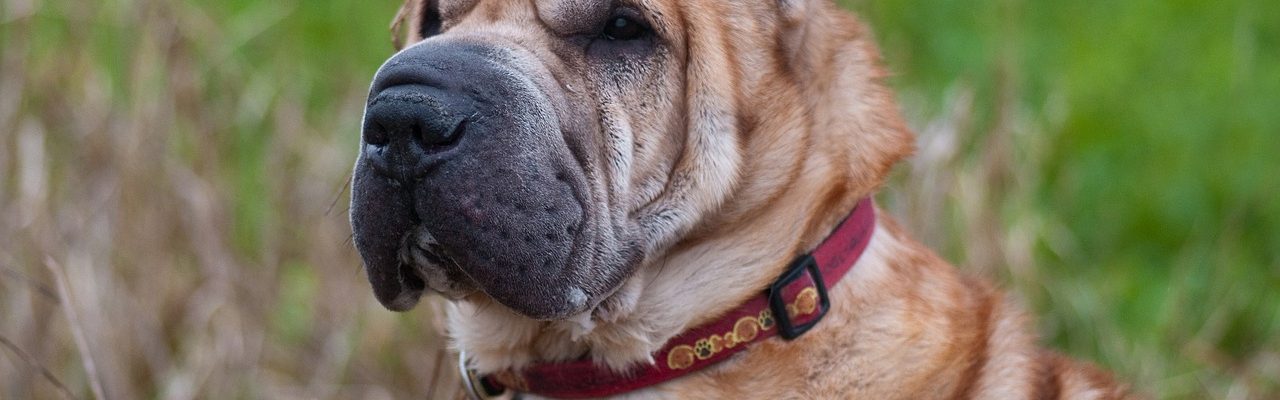
Health Issues that may effect the Shar-Pei
In general, dogs with any of the following conditions
should not be bred. You want to make sure that the parents of the puppy
you may be considering have been cleared or checked for any of these
conditions.
If your veterinarian requires more information about
the Chinese Shar-Pei, send the name and address of your veterinarian
(for overseas orders, send $2.00 in U.S. funds for postage) to:
Jeff Vidt, DVM
210 S. Park Street
Westmont, IL 60559-1940
Entropion
The Shar-Pei are 1 of 14 breeds that can have this
condition. This is where the eyelid rolls in towards the eye, rubbing
against the cornea and irritating this sensitive structure. Watery eyes,
infection, even a corneal ulcer, can occur. Surgical correction may be
required. Dogs with this condition should not be bred, as a genetic
component is suspected.
Eye Tacking
Puppies open their eyes at about 10-14 days of age. In Shar-Pei,
this is often when the first symptoms of entropion appear. Typically
the puppies open their eyes, but quickly they begin squinting and
closing them. Often there is a mucous eye discharge and these
puppies usually don't eat well or gain weight like their
littermates. EYE TACKING is a temporary measure in which sutures
(stitches) are placed in the eye lids to roll the lids "out" of the
eyeball. Often this can be done without anesthesia in very young
puppies (2-4 weeks of age). Sometimes gas anesthesia is used. Nylon
sutures are placed in the eyelids which opens the eyes. Often an
antibiotic eye ointment is dispensed to help heal any corneal ulcers
and prevent secondary bacterial infections. These sutures are left in
place for as long as possible - up to 4 weeks in some cases. The
tacks can be replaceed as needed until a permanent repair procedure
can be done. If the sutures loosen up or are causing problems, they
can be removed. Eye tacking can result in permanent repair of
entropion, but its primary goal is to prevent serious eye damage
until the pup is old enough to undergo permanent entropion repair -
around 6-8 months of age. Puppies who have their eyes tacked may or
may not need permanent entropion repair later on - there is not much
correlation between the two.
ENTROPION IN YOUNG PUPPIES CAN RESULT IN CORNEAL ULCERATION AND
IS A MEDICAL EMERGENCY - SEE YOUR VET IMMEDIATELY!
Entropion Surgery
Permanent ENTROPION SURGERY is often done in Shar-Pei after they
reach the age of 6-8 months old. This is the age at which most pups
are full grown and have "grown into" their heads. Permanent repair
is a surgical procedure that will result in correction of the eyelid
problem. Its success depends on the experience and artistry of the
surgeon and often times referral to a veterinary ophthalmologist is
recommended. The procedure involves various techniques to remove
excessive eyelid tissue from the lids, tighten up the eye opening
and sometimes remove extra folds of skin around the eyes.
Typically
the dogs look worse for a few days after the surgery due to the
swelling that occurs and they often sport an Elizabethan or
"lampshade" collar to protect the sutures. Stitches are usually
removed in 7-14 days.
It should be noted that CSP’s eyes can be very sensitive to allergies and
can swell shut due to environmental allergens (dust, cigarette smoke), this can
cause the appearance of entropion but doing the surgery will not solve the
problem. Tracking down the offending allergen and removing it from the
environment will correct the problem. Entropion can also be cause by stress –
commonly referred to as "stress entropion" – this is again a
temporary situation and once the dog is removed from the stressful situation,
the eyes will recover. If their cornea gets a scratch, or if they bump their eye
again the tissue surrounding the eye can swell, causing the eye to shut, tacking
is advised for these situations, as it is a temporary problem.
Cherry eye
Cherry eye – protrusion of the third eyelid - is another fairly common
problem in the breed. The gland for the third eyelid becomes unattached and can
be seen a round red blob in the inner corner of the eye. When particularly large
it can in fact obscure the entire eye. Whilst it doesn’t hurt the dog or
affect it in any way it is unsightly and if left untreated can cause problems.
Treatment consists of surgery to place the gland back into place and tie it down
with sutures. This type of surgery is generally very successful though there are
rare occurrences when the gland pops back out. If this should happen then it is
generally recommended that the entire gland be removed. Should the gland itself
be removed then drops have to be put in the dog’s eye for the rest of its life
to prevent what is commonly referred to as "dry" eye. It should be
noted that if one of the glands comes lose, the other eye will also be affected.
Should this happen to your dog it is worth trying to wait an extra couple of
weeks, if possible, to see if the other gland goes so your dog doesn’t have to
go through two doses of anesthesia in a short period of time. Unfortunately,
there is no way "preventive" surgery can be done, the gland actually
has to come out before it can be repaired.
Hypothyroidism
The thyroid glands secrete a hormone which controls
the basic metabolic rate of the entire body. Inadequate hormone levels
reset the body to function at a lower metabolic level. In that case,
dogs fatten easily on a normal diet, become sluggish, and are easily
chilled. Hair changes are most noticeable and include loss of hair from
the flanks and back, increased pigmentation of the skin, scaling and
seborrhea (an abnormality in the production of skin cells.) Secondary
bacterial infection of the skin is common. The ears may also be
affected, filling with thick, yellow greasy material which may
predispose the dog to ear infections. Blood tests will determine the
level of thyroid function and administration of thyroid hormone can
treat the condition.
Familial Shar-Pei Fever and Amyloidosis
Familial Shar-Pei fever also known as "Swollen Hock
Syndrome" (SHS) typically may include the following symptoms:
- Swelling of the hock joint and sometimes other joints can be
affected.
- Reluctance to move.
- Sometimes a swollen painful muzzle.
- Abdominal pain, vomiting, diarrhea, and shallow breathing.
"Familial Shar-Pei Fever (FSF) is an episodic fever
disorder. Shar-Pei with this disorder have one or more bouts of
unexplained fever, usually 103-107 degrees but rare cases may go higher.
Fevers usually start when they are less then 18 months old but sometimes
the first attack is not until they are adults. Fever episodes usually
become less frequent with age. Fevers last 24-36 hours in most cases
without treatment". The disorder is "thought to result from an inability
to regulate the immune system. Dogs suffering from this disorder are at
risk of dying from a related disorder, amyloidosis. Affected Shar-Pei
with amyloidosis have an inability to break down chemicals released in
the bloodstream when inflammation results from abnormal deposition of
amyloid protein throughout the body. While not all dogs with Shar-Pei
fever die of amylodosis, when they do, death most commonly occurs
between the ages of 3 and 5 years".
Demodectic Mange
Read more on Demodex
Demodectic mange is caused by the demodex mite, ALL
dogs have these mites living in their skin. In a healthy animal the
parasite and host co-exist in relative harmony. The dog's own immune
system will keep the numbers of the mites in check and maintain the
balance. Certain periods of growth (adolescence) or times of stress
(vaccinations, coming into heat for bitches) can cause temporary
impairment to the dog's immune system, which leads to a proliferation in
the mites numbers. What will be seen is small patches of hair loss
(generally circular) particularly on the head and sometimes on the
trunk, this is referred to as juvenile or localized demodex. Current
veterinary theory is to leave such small patches well alone, in a
healthy puppy or dog the immune system will re-assert itself, the
patches of hairlessness will recede and the hair will grow back. More of
a problem is when the immune system cannot, for some reason, cope with
the large numbers of mites and it turns into generalized demodex.
Generalized demodex shows large numbers of mites in a skin scraping,
large patchy hair loss, and in very bad cases, total baldness. Dogs with
generalized demodex have a faulty immune system and should NOT, under
any circumstances, ever be bred. Treatment consists of Mitaban dips once
every two weeks until several concurrent negative skin scrapings have
been obtained or more popular now, Ivermectin given either orally or via
injection. Mitaban is a highly toxic chemical, and care should be taken
when using it both for the people and the dog, use in puppies under six
months is contra-indicated and dips should NEVER be closer than two
weeks apart. Ivermectin as a treatment of demodex is becoming more
popular and is generally considered to be less toxic on the dog's
system. Whichever method is used though, it should ALWAYS be done with
veterinary supervision.
Seborrhea Oleosa
Severe rancid body odor which comes from raw, scaly,
bloody skin. Could be caused by hypothyroidism, yeast infections, and or
food allergies. This situation should be immediately discussed with a
veterinarian and the appropriate shampoos and medication can effectively
treat this condition.
Ears
Due to the breed standard calling for small ears,
this results in the Shar-Pei having very narrow ear canals.
The primary problem with ear cleaning
in the Shar-Pei breed centers around inadequate training and lack of
control of the dog. If the dog will not let you clean the ears you
will not be able to treat the ears. The training process begins in puppyhood and involves discipline and positive reinforcement methods
which are beyond the scope of this article. Suffice it to say that
you should train you dog as a puppy to tolerate ear cleaning.
I will also be the first to say that some of the problem in cleaning
the ears rests in the most common method of ear cleaning used today
- the cotton swab. Improper use of the cotton swab results in trauma
to the ear canal with swelling, pain and an uncooperative patient.
The best way to clean the ear canal is to "float" debris out of the
canal using an ear cleaning solution. A wide variety of such
solutions are available on the market with none being better than
any of the others. Try different ones and see which works best for
you. My personal favorites are Pan-Otic and Nolvasan Otic. Do not
use hydrogen peroxide! The foaming action bothers the dog and
the peroxide breaks down into oxygen and water in the ear. It is
usually wise to clean the ears outdoors because the principle here
is to allow the cleaning solution to loosen the debris and the dog
to shake the material out of the ear.
The ear canal is filled up with the cleaning solution, gently
massage, and then the dog is allowed to shake its head. Stand
Back! Material tends to catch on the inside of the ear flap
where it is wiped off with cotton balls and the whole process is
repeated. This is done several times until no more debris in
collected. At this point a cotton swab can be gently inserted into
the ear canal to soak up any remaining ear cleaning solution. Do not
clean the ear with the cotton swab! After the ear is thoroughly
dried, the appropriate ear medication is instilled into the ear
canal as directed by your veterinarian. It is often a good training
technique to give the dog some sort of a special treat at this point
to positively reward the dog. This may make future sessions more
pleasant. In ears that have severe disease, it is often a good idea
to treat the ear for several days with medication first before
attempting to clean the ears. This allows the swelling and pain to
subside first and allow the dog to tolerate the cleaning procedure
better. In such cases it may also be a good idea to have your
veterinarian anesthetize the dog and clean the ears before any home
therapy is done. This also allows your veterinarian the opportunity
to examine the ear more thoroughly.
Carpal Laxity
This is a weakness is the carpal ligaments which
causes instability and bowing forward in young puppies. Decrease the
protein level and exercise on a non-slippery surface. In severe cases
soft wraps will be in order.
Patellar Luxation
Is where the knee cap slips out of its socket. Any
Shar-Pei with this condition should not be bred.
Hip Dysplasia
A dysplastic dog has an abnormal hip joint where the
femur and acetabulum are misaligned. This can range in severity from
mild (controllable) pain to dogs in such agony they must be put down.
Make sure the parents of any puppy you consider has been cleared of Hip
Dysplasia through the Orthopedic Foundation for Animals.
Regurgitation/Vomiting
"Megaesophagus and or diaphramatic hernias may not be
detected until the dog is much older when they will appear underweight
or emaciated with a history of vomiting. This is a developmental defect
possibly a delayed maturation of the esophageal nueromuscular system.
Mild cases in young dogs can improve with careful feeding." Feeding the
dog by elevating the food in such a way as to raise the dog's front end.
Putting food bowls on a stair or two and then allowing them some time to
digest in the same position may help.
Cutaneous Mucinosis
"Mucin is the substance in the Shar-Pei skin that
causes all the wrinkling. It is clear and stringy and acts like glue in
fight wounds." Some Shar-Pei have an excess of Mucin causing it to form
clear bubbles on the skin that may rupture and ooze. May be associated
with possible allergies and can be treated by a alternate day steriod
therapy.
Mucin is what makes Shar-Pei skin wrinkle and gives
them padding on their muzzles and hocks. It is normal for
Shar-Pei. Sometimes excessive mucin bubbles up in the skin,
forming vesicles. This is called cutaneous mucinosis. These
vesicles can be fragile and spontaneously break if the condition is
severe or the bubbles of mucin may rupture during rough play, etc.,
causing the sticky substance to ooze out. It is normally not a
problem for the dog. If it is excessive, e.g. causing much
spontaneous rupture followed by healing scabby areas or if the skin is
tearing frequently, the production of mucin can be shut down by low
dosages of prednisone or other corticosteroids. Usually very low
doses of alternate day prednisone result in dramatic improvement.
If it is not bothering the dog, I would not treat it because
corticosteroids are not without risk. Sometimes Shar-Pei will
“lose” their muzzles because of steroids administered medically or
because they are stressed by fever or illness and their own body’s
production of cortisol by the adrenal glands will cause the mucin to
“shrink”. Usually, they will return to normal with time but
sometimes they never regain their old appearance.
Mucinosis frequently occurs on the neck, forelimbs, shoulder area, hocks
and about the anus.
This is a picture of Shar-Pei skin with cutaneous mucinosis:
Torsion/Bloat
Being one of many deep chested breeds, bloat can
occur in Shar-Pei. Can also be caused by the way you roll your dog.
Although similar to colic in horses, "bloat and torsion occur when the
stomach swells with gas and then twists and cuts off its blood supply.
Without timely surgical intervention the condition is fatal". The dog
must see a veterinarian as soon as possible.
Chronic Inflammatory Bowel Disease
Often complicated by food allergies and or Chronic
stress diarrhea. Usually responds to a strict hypoallergenic diet.
Cancer
"In regard to cancer, several forms have a high
incidence in the breed. At present, the CSPCA is surveying club members
to determine which are most prevalent. Once isolated, the organization's
Charitable Trust plans to fund relevant cancer research".
Allergies
| Both inhalant and food allergies
are very common in most dogs. The symptoms generally express
themselves in hair loss, intense itching and infected ears, the
skin between the toes of the feet might well be swollen and red.
Allergies are caused by an over-reaction of the immune system
and again can be split into two groups, acquired and inherited.
Acquired allergies show up in a mature dog which previously
never had any problems. Trying to find the offending substance
can be like searching for a needle in a haystack, various
allergy tests are offered and can be either by the traditional
"skin scrape" method or by blood tests. The blood test is mostly
used in an attempt to track food allergies, it is not a terribly
reliable test, but it is useful in indicating what direction to
go in. The "skin scrape" is similar to the kind of testing done
in people. Food allergies whilst hard to
track down are also relatively easy to treat - the offending
food substance is removed from the dog's diet. The best way to
prevent food allergies is to feed your dog a high quality,
PREMIUM dog food, without soy, corn or wheat.
Inhalant allergies are, for the most part,
impossible to treat. The best that can be hoped for is
maintaining the dog as comfortably as possible. Inhalant
allergies are generally worse in the summer and fall when
pollen, molds and seeds are abundant. As with people, it is
possible to get "allergy" shots for dogs which might help to
alleviate some of the symptoms.
Inherited allergies will generally show up in
a much younger dog, sometimes as young as three months but
nearly always by the time a dog has turned a year. Again dogs
with inherited allergies should NEVER be bred. The treatment for
dogs with inherited allergies is the same as for those with
acquired.
Another very common cause of skin problems are fleas. Many dogs
are very allergic to the saliva of the flea. Symptoms are
intense itching and scratching; it can take only one bite to set
a severely allergic dog into ripping its skin apart. The best
solution for fleabite allergies is PREVENTION. These days there
are some excellent flea preventives available, both Frontline
and Advantage are highly recommended, Program is another method,
however this particular method does not actually kill the fleas
that are biting your dog but sterilizes them so they can’t
re-produce. If fleas are a problem they you also have to treat
the environment your dog lives in by removing fleas from your
house and yard.
|
Diet
Food allergies may cause skin and stomach diseases.
This breed should have a well balanced, preservative free diet and one
that is low in protein, approximately "(16-21%)." Some alternatives to
rawhide and store bought treats are raw or cooked veggies when ever you
are steaming some up for yourself, nothing from the cabbage family or
onions, and most fruits such as bananas, apricots, apples, etc. are also
healthy alternatives to store bought treats. No table scraps because we
as humans tend to dress up our veggies with butter, margarine, salt,
sugar, and/ or gravy. Anything with soya or beef, dyes, or chemical
preservatives liked BHA, BHT, or Exthoxyquin should be avoided. Instead
look for foods that are preserved with vitamins A, C, or E. A
chemical-free food is often enough to make a huge difference in a dog's
health.
Grooming
The Shar-Pei requires minimal maintenance. Brushing
with a good bristle brush every other day keeps its unique coat in
excellent condition. Bathing may occur occasionally using warm water and
a good shampoo recommended by a vet. Contrary to popular belief the
Shar-Pei do not need to be bathed every week. This constant bathing will
make the skin dry (increase itching) and cause the coat to look dull. By
doing this you will wash all of the dog's natural oils away. Only bath
the dog if he/ she smells with a vet recommend shampoo for general
bathing needs. The nails of a Shar-Pei grow fast so frequent clipping is
in order. Always touch your puppy's paws and the puppy all over to get
them used to grooming. Because the Shar-Pei have tiny ears frequent
cleaning is a must. Usually once every week or every two weeks depending
on the individual dog. Use cotton swabs or make-up pads (cotton ones)
with an ear solution from your vet. Do not use Q-tips as it may push the
waxy build-up further down the ear canal. After you have cleaned the
ears let them shake and then later clean the excess. The ears, eyes, and
the whole body in general should be inspected frequently to have a
happy, healthy Shar-Pei.
Puppy Buyer's Guidelines
These are just a few suggestions a new prospective
owner of a Shar-Pei puppy should be aware of and consider when looking
for a new puppy:
* Puppies should at least be 8 weeks of age before
going to a new home. A puppy needs adequate time with his/ her
littermates and mother for proper socialization to begin.
* Buyers should see both parents. "Although it's
normal for a Shar-Pei to behave in a standoffish manner when in the
presence of strangers, neither the sire nor the dam ( nor puppies)
should behave in a shy or aggressive manner.
* Buyers should look for a puppy that is confident
not shy, aggressive or fearful.
* Health should be of the utmost importance for a new
prospective owner. No discharge from the eyes or nose, distended or
potbellied abdomen, dull coat, and no lethargic behavior.
* Check with the kennel club in your area if you are
not sure about what papers you are entitled to, but you should not be
asked to pay extra for the registration papers of your new puppy. Papers
included in the purchasing price of your pup are a signed pedigree,
copies of the contract of sale and health guarantee, a complete health
record that includes the dates of worming and a veterinarian's
certificate proving inoculation. "The breeder also should provide
written proof he or she will take the puppy back within a limited period
of time if it is found to be ill or suffering from some defect. Dogs
should be examined by a veterinarian within 48 hours of the sale. Pet
quality dogs should be sold with a spay/ neuter contract or limited
(i.e. non-breeding) registration".
NO Grapes or Raisins
Grape and Raisin Update: based on report provided by VMRCVM
Veterinary Notes (a bimonthly publication of the school)
Animal Poison Control Center has documented multiple cases of
grape and raisin poisoning in dogs within the last couple of
years. Presumably this has occurred for years but has been
attributed to other causes in the past.
The source of the problem has been varied. Grapes of all
varieties and growing conditions (including homegrown) have been
implicated. Raisins are usually made from white seedless
grapes, but all raisins of any source should be considered
kidney toxic (chocolate covered raisins as well).
The toxic principle is unknown. Grapes contain low amounts of
tannins compared to acorns, a known kidney toxicant in large
animals. Grapes lack significant amounts of Vitamin D, another
known kidney toxicant. It is unlikely pesticide residue is
involved due to the wide variety of grape types involved.
So far the majority of toxicosis reports have been in dogs. The
minimum toxic dose is approximately 0.3 oz/kg body weight. This
would correspond to about 2 grapes per kg body weight. Raisins,
having lost their water content are considered more toxic at 0.1
oz/kg body weight (or 6 raisins per kg). Feeding grapes or
raisins to cats and ferrets should also be discouraged, as
poisonings have been reported in these species as well.
Clinical signs onset within 6-24 hours after ingestion (average
is 12 hours). Initial signs are GI related followed by kidney
problems. Vomiting is usually the primary sign, with diarrhea,
depression/lethargy, anorexia, colic, dehydration and sharply
decreased urine output. The course of the toxicosis is anywhere
from 3 days to 3 weeks. Dogs with kidney problems have a
guarded to poor prognosis.
Diagnosis is based on history of recent exposure and clinical
signs. On bloodwork, the kidney values are increased.
Typically BUN, creatinine, phosphorus and potassium are elevated
(sometimes serum calcium as well). The urine sediment will have
hyaline casts and the urine specific gravity will be either
hyposthenuric or isosthenuric (diluted to the concentration of
water of less concentrated than water) at SG 1.006 to 1.010.
Treatment is based on preventing further absorption if
appropriate and maintaining urine output and electrolyte
balance. If the raisins or grapes have been ingested within 2-3
hours, vomiting should be induced followed by activated charcoal
to limit further absorption and an osmotic cathartic (to speed
up GI passage of toxin without absorption. The animal should
receive an isotonic saline solution IV at twice maintenance
rates for 48 hours. Anti-nausea medication, diuretics and
peritoneal dialysis may be needed in some cases.
|